top of page


16. oktober 2026
PASTA, OYSTERS AND THE PROBLEM WITH PERFECT CONDITIONS
by Jakob Hindhede
News, Read
This is the story of a boy... a story of someone who just followed a thirst to do something.
It was not something big, but something that felt important, at least to someone he didn't know.
Yet…

bob_petra · the anti gallerist
Eleven years down the road, it might be time to admit that none of this started with a grand spreadsheet, a big business plan or any real idea of where it would end up.
I just wanted to create a place where ideas could live a little longer than usual.
Back then, I think I was mostly reacting to a shift in the culture around me.
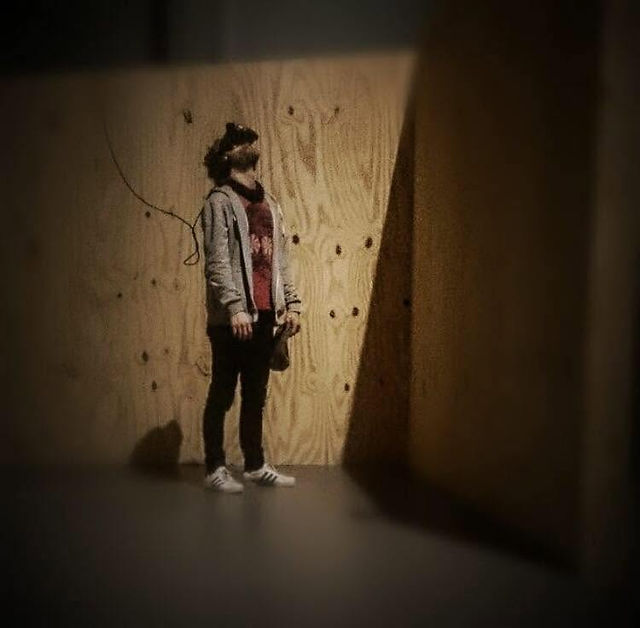
The familiar social platforms were changing, the way we communicated was changing, and as an artist it could be surprisingly hard to figure out where you were actually supposed to go if you wanted to meet people, show something, start something or just have a conversation that didn't disappear into a feed.
I knew that feeling myself.

At the same time, I also had this growing thought: where the hell do you look if you want to experience something outside the usual high-culture machinery?
I figured I probably wasn't the only one asking.

So in 2015 I started what was then called Novam Artem.
The first event was Kunst i Kaffen, an art walk around Nørrebro.
It was basically built from people I didn't really know, places I had mostly visited because I was thirsty for coffee, and an idea that somehow seemed worth trying.
Nothing particularly grand, but enough to get things moving.
That feeling has probably followed Art Monday ever since.

LIKE WRITING A SONG WITH A BAND
One thing I definitely brought with me from earlier creative work was the idea that you don't always need to arrive with the finished version.

If you write something together, the interesting part often happens when other people enter the room. Someone brings a starting point, someone else changes the direction, and suddenly you're building something that none of you would have made alone.
That was very much how I approached Art Monday from the beginning.
I could find a venue, make a basic plan and create some kind of frame, but I didn't want to arrive with a finished answer. The point was to find out what could happen when other people stepped into it.
Maybe that is also why I have never really fitted neatly into one role. Gallerist, curator, publisher, organiser, practical sparring partner, artist.
Probably a bit of all of it.


With projects like this, you can't really separate the romantic part from the practical part anyway.
At some point somebody still has to move the table, hang the work, write the text, answer the messages and figure out why the fucking extension cord isn't long enough.
Sometimes you simply have to jump in at the deep end.

LET'S JUST FUCKING DO IT
After the first four or five exhibitions around Nørrebro, I somehow managed to put together something much bigger at Dome of Visions that same summer.
The whole thing came together within roughly four months of the very first event.
I was the one pushing it forward, making the calls, finding the people and trying to get all the pieces to meet in the middle.
When time got tight, good friends stepped in and helped carry it over the line.

What started as a small art walk had suddenly turned into something close to a festival, with visual art, music and performance under the same roof.
And somehow I walked away from it with a loss of around 1,500 DKK. No funding!


I remember thinking: this is actually fun.
There might be something here.
Not because losing money is a particularly brilliant business model, but because people had shown up. Artists wanted to take part. Audiences came. A place like Dome of Visions had opened its doors, and a strange little idea had suddenly become something people were willing to put their own energy into.
I think a large part of the attraction was a certain sense of rebellious and foolhardy recklessness. A kind of:
"Fuck it, let's just do it."

The artists could feel that.
And yes, being able to say "Dome of Visions" obviously didn't hurt either. A strong venue gives people something real to imagine themselves inside. Whether you were making visual art, performance or something else entirely, there was suddenly an actual space where the idea could happen.
But I think the energy mattered just as much.
It wasn't about waiting for somebody else to approve the project. We weren't sitting around hoping for a foundation, an institution or a gatekeeper to tell us whether the idea was worth pursuing.
If we believed there was something in it, we tried to build it.

People sometimes talk about the line between spontaneity and quality. I honestly don't know where that line is.
Maybe the more useful question is whether you're acting stupidly based on the resources you actually have.
If you have 10 kroner for dinner, the relevant question is probably whether you're eating penne or spaghetti. Not whether oysters would technically be a better meal.
If pasta isn't good enough, I guess you can go to bed hungry.
Working quickly obviously has its limits. If the time between an idea and the event is short, fewer people will hear about it. Fewer people will experience it before it disappears again. Bigger applications and funding processes also become harder to fit into that rhythm.
But there is another side to waiting.

If you spend a year at the bus stop waiting for the perfect bus, ten perfectly good ones have probably driven past.
And you still missed dinner.
Eleven years later, I still believe there is value in acting while an idea is alive. Sometimes you get a punch in the stomach. Sometimes you somehow end up eating oysters galore with a good bottle of white wine, despite starting with 10 kroner in your pocket.
You rarely know which one it will be beforehand.
CURIOSITY BEFORE CERTAINTY
I can't really explain where that urge comes from. Maybe I just have a screw loose. Maybe I should have started taking pills much earlier, and the world would have looked very different, both to me and to everyone standing around watching.
Or maybe it is simply curiosity, a curiosity that I stubbornly refuse to grow out of, whether I'm 20 or 200 years old.
Fine. I probably won't make it to 200. Probably.
A little Kunst i Kaffen never hurt anyone.

But eleven years of making things has changed something. Experience has made me more cautious in some ways. Less impulsive.
You learn that collaboration has a cost.
You meet a lot of people.
Some stay, some leave, some become partners, some become friends, and others become a story you tell yourself about why you'll probably do things differently next time.
It can make you tired. It can also make you better at lifting things together with the people around you.

I'm still not afraid of doing things, but when I look inward, I can see a person who is a little more held back than he used to be. I don't necessarily think that's a bad thing.
The impulse is still there.
I still believe in people in an almost naive way.
I still believe people want to create, take part, help each other and start things.
If I stopped believing that, there wouldn't be much point in continuing.

THE FLOCK
I sometimes call the people around Art Monday "the flock".
Who is in it?
Basically, everyone who is here right now.
If somebody becomes too busy to take part, socially or creatively, they slowly step outside it themselves. It takes quite a lot for me to decide that somebody is no longer part of the larger story.
That is probably both a strength and a weakness. Depending on which day you ask me.

A lot of people have passed through Art Monday over the years. I am still the one who usually starts the engine, but that doesn't mean every idea has to be mine.
Sometimes Art Monday is the collaborator. Sometimes it is the platform. Sometimes someone arrives with an idea and I try to help build the conditions around it.
Some of those projects work brilliantly. Some get swallowed by time.
Some people see the opportunity, get inspired and then discover that taking an idea beyond the exciting first conversation takes something else entirely.
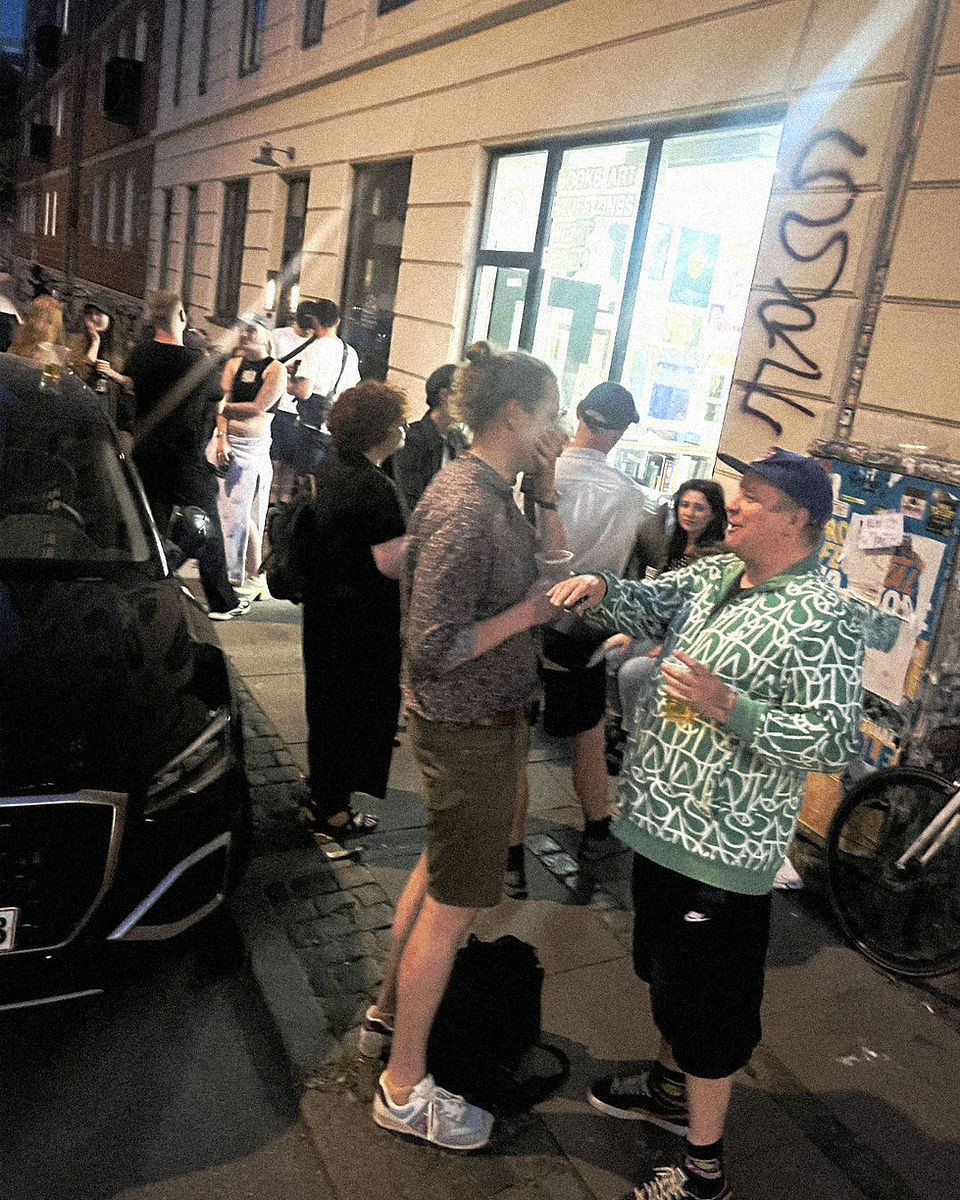
Everyone likes the idea of opening that little shop, or saying I wish I'd opened that bakery.
The difficult part is showing up again the following morning.
And the morning after that.

ONE IDEA, MANY DIRECTIONS
Today, what started as a small experiment has grown into several branches, formats and projects.
But the underlying idea is still pretty simple.
Create a framework. Invite people in. Take the work seriously without necessarily taking all the machinery around it too seriously. Let different directions exist next to each other.
That is also why the rainbow has stayed with us.
It doesn't really explain Art Monday, and I don't think it needs to. It simply reminds us that a lot of completely different things can grow from the same starting point.

Some people come into Monday Studio to pick up a work of art, a book or a T-shirt.
Others stay for coffee or a cold beer, and suddenly two hours have passed and the conversation has ended up somewhere none of us expected.
That has always been my favourite version of it.
Maybe Art Monday was never really built around having the right answer.
Maybe it was built around continuing to ask:
What happens if we try?


-_-


bottom of page